
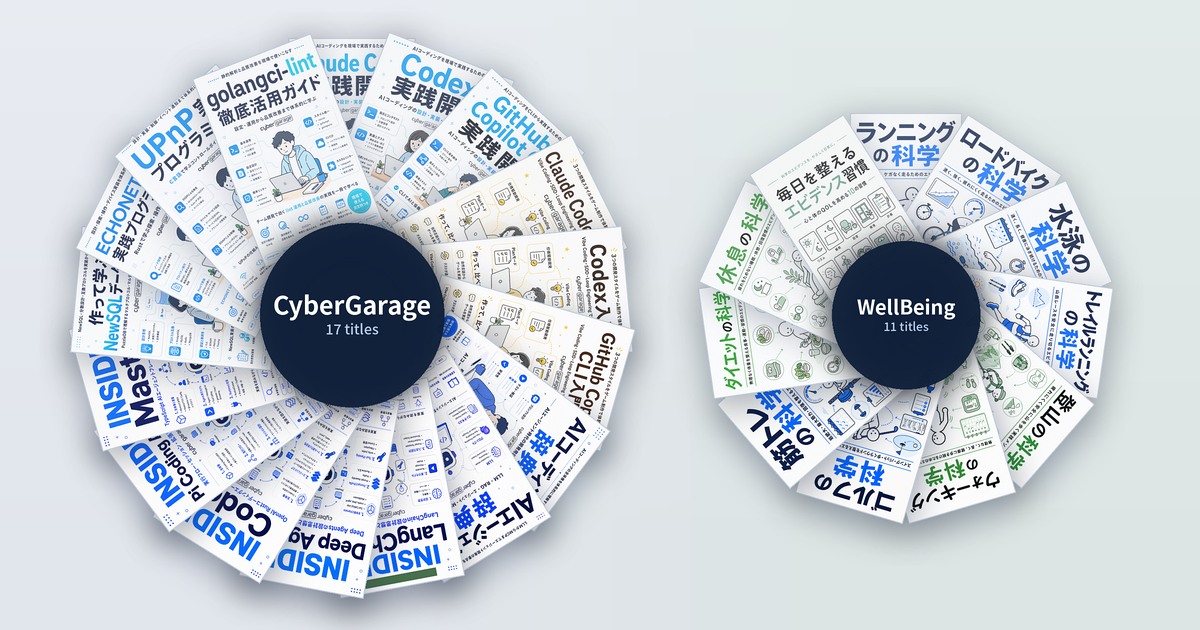
Between July 2 and August 14, 2026, I published 28 technical and practical books on Kindle Direct Publishing (KDP) — totaling 354 chapters and 3,259 sections. The work behind this pipeline is why both my open-source projects and this blog have been quiet for the past few months.
Publishing Overview
The publications fall into two main categories: technical titles and quality-of-life (QOL) titles. Because their target audiences rarely overlap, they are separated under two author names:
- CyberGarage — Technical titles: AI, practical programming, NewSQL, and IoT.
- WellBeing Lab — QOL titles: Exercise, health, and sports science.
Six Weeks in Numbers
Based on completion dates, I published 28 books in the 43 days between July 2 and August 14, 2026 (19 in July, 9 in August). Across all volumes, the output reached 354 chapters and 3,259 sections.
| Author | Books | Chapters | Sections |
|---|---|---|---|
| CyberGarage | 17 | 252 | 927 |
| WellBeing Lab | 11 | 102 | 2,332 |
| Total | 28 | 354 | 3,259 |
While CyberGarage accounts for more individual titles, WellBeing Lab contains more than twice as many sections. This disparity stems from the fundamentally different structural designs required for each domain.
Work on the earliest title began on March 6, but early progress was exploratory and largely stalled. Production began in earnest in late June—13 of the 28 books were conceptualized and finished after that point.
Technical Architecture & Pipeline Design
Currently, the entire codebase and content library are managed in a single monolithic repository. Scripts, helper utilities, and prompts are shared across the repository, with specialized modules isolated by book category. Writing speed accelerated dramatically only after this repository-wide refactoring was finalized.
1. AsciiDoc as the Single Source of Truth
Every manuscript is authored in AsciiDoc, a format I was already familiar with from my open-source work, and compiled to EPUB via Asciidoctor. Three key properties made this approach effective:
- Plain Text Source Control: Manuscripts live in
git, making every iteration a readable diff. Tracking how an AI agent altered a chapter overnight viagit diffbrings software engineering rigor to book authoring. - Native AI Agent Interoperability: This was the deciding factor. Eliminating binary formats or proprietary editors allows AI coding agents to inspect and manipulate source files directly using standard developer tools.
- Flexible EPUB Conversion: The build uses asciidoctor-epub3, with roughly twenty custom scripts to correct Asciidoctor-specific behavior and another twenty tailored to KDP-specific requirements.
2. Multi-Agent Workflows
WellBeing Lab (QOL): Unified under Codex
Both prose generation and diagram creation run entirely on OpenAI's Codex.
Initially, I rotated between Codex, Claude Code, and Gemini depending on the task. Eventually, I consolidated the entire pipeline into Codex. Once the structural granularity for chapters and sections was stabilized, production became a matter of running 11 iterations of the same standardized flow. Unifying under one engine ensured consistent formatting and tone of voice.
This isn't strictly Codex-dependent. Claude Code—and to some extent Gemini—can execute the same pipeline once minor output differences are normalized. As long as the execution steps and prompts remain abstracted in text, the underlying LLM engine remains hot-swappable.
CyberGarage (Technical): Orchestrating Codex, ChatGPT, and Claude Code
These books require analyzing real-world codebases and repositories, so I alternate tools based on the domain.
For illustration generation, requesting complex diagrams through Codex directly often hits limitations. To solve this, a prompt-generation batch pipeline hands off image tasks to ChatGPT for rendering and retrieval.
3. End-to-End Automated Workflow
Below is the 13-step build pipeline, taking WellBeing Lab as an example (reference-style technical books use a simplified version of this flow):
| Step | Task | Execution | Decision Engine |
|---|---|---|---|
| 1 | Select category & initialize design specs | Command | Human |
| 2 | Generate skeleton & run dry EPUB build | Command | — |
| 3 | Query research candidate papers per chapter | Command | — |
| 4 | Evaluate paper candidates for inclusion | Command | Prompt |
| 5 | Merge accepted content & flag duplicates | Command | — |
| 6 | Draft text content (text-only pass) | Command | — |
| 7 | Run duplicate checks & style/grammar linting | Command | — |
| 8 | Output review audit table | Command | — |
| 9 | Select featured items, reorganize section ordering | Command | Prompt |
| 10 | Generate images & normalize aspect ratios/margins | Command | — |
| 11 | Sort internal section elements | Command | — |
| 12 | Compile EPUB artifact | Command | — |
| 13 | Final pass reading & clear residual overlaps | Command | Prompt |
All 13 steps are executed via CLI commands.
The only manual entry point is declaring the initial category name. From there, I monitor usage quotas and execute the pipeline commands. While these prompts were initially written as human instructions, the process now runs fully autonomously with agent-driven decision-making.
From 141 Days Down to 5 Days
Formalizing decision criteria into structured prompts created a dramatic shift in lead times starting in late June:
- March Phase (Initial 5 books): Averaged 141 days to completion.
- Late June Onward (13 books): Averaged 19 days to completion.
- Fastest Releases:
- CyberGarage: 5 days for INSIDE Codex (16 chapters, 16 sections).
- WellBeing Lab: 6 days for The Science of Golf (10 chapters, 230 sections).
The inaugural title, Evidence-Based Habits for Better Days, required extensive manual edits during its initial run. Ultimately, the entire manuscript was re-generated from scratch using the new automated pipeline prior to publication.
For WellBeing Lab titles, Codex reasoning effort is set to high (model_reasoning_effort="high"). At roughly 250 items per volume, generating a single book consumes nearly two weeks' worth of a ChatGPT Pro rate limit. I optimized production around these rate-limit reset cycles to keep batches moving smoothly.
What’s Next
On the CyberGarage side, I am authoring advanced, production-oriented books on C, Go, and NewSQL aimed at practicing software engineers rather than beginners. On the WellBeing Lab side, the production pipeline is fully mature, allowing me to turn any personal research topic into a published book systematically.
However, spending the last six months focused heavily on publishing meant my open-source (OSS) projects were largely put on hold. Now that the automated pipeline is established and the cost per book has dropped dramatically, I plan to dial back the writing pace and shift my core focus back to software engineering and OSS development.