
/ LAB NOTES / ENGLISH
AI Agent Design and Implementation: Connecting Research, Standards, and Open Source
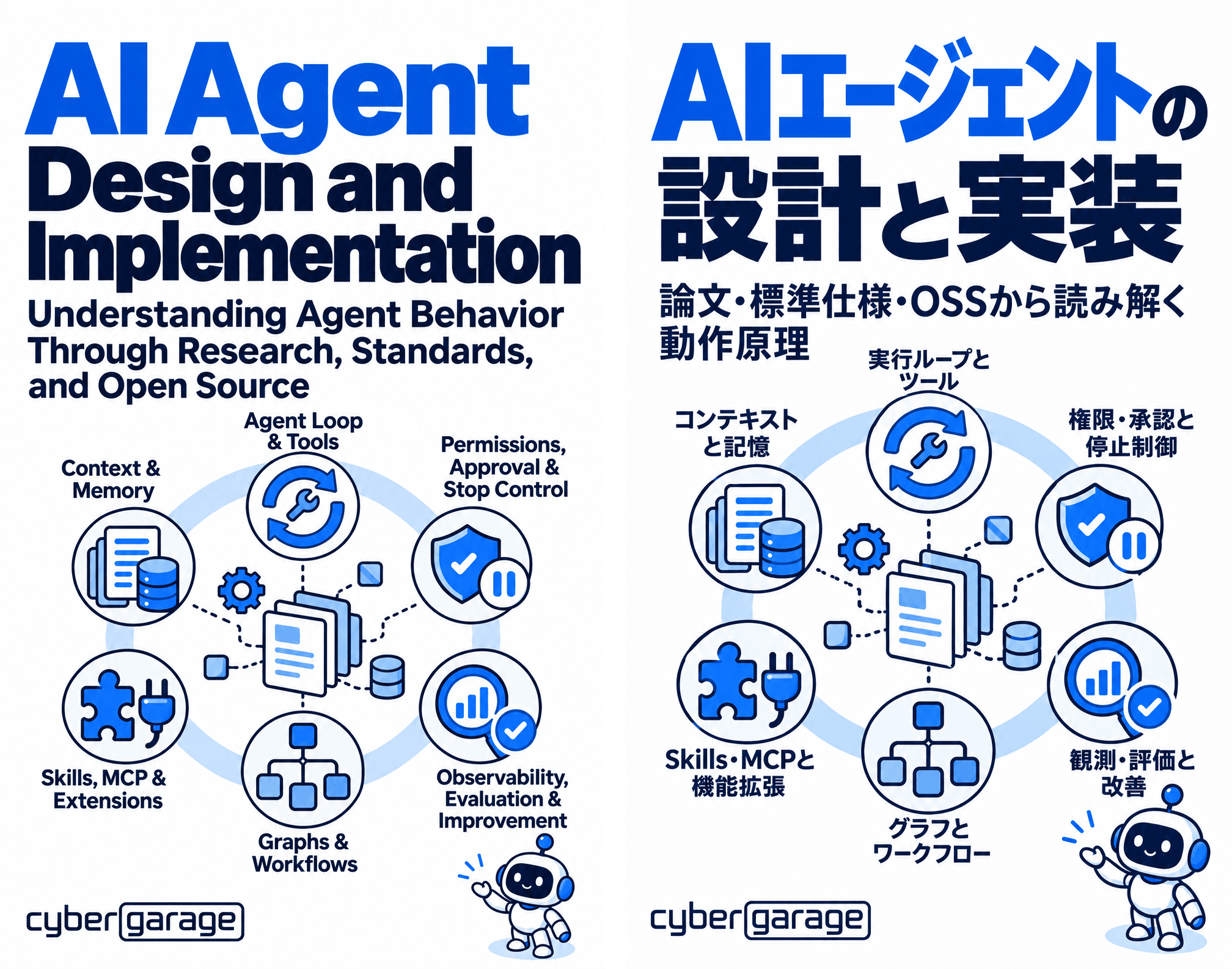
I have published AI Agent Design and Implementation: Understanding Agent Behavior Through Research, Standards, and Open Source, available in English and Japanese.
The book brings together research papers, standards, and open-source implementations to explain how AI agents work—and how their design choices affect execution, context management, and ongoing tasks.
On this page3 sections
From research to working systems
An agent’s behavior depends on its model, tool execution, permissions, retained context, and workflow control. These components shape what the system can do and how it responds when something goes wrong.
The book connects these responsibilities through several perspectives. Research such as ReAct, CodeAct, CaMeL, and ADAS provides methods and design questions. MCP, Agent Skills, and model API specifications describe interfaces and reusable mechanisms. Open-source implementations—including Codex, Pi Coding Agent, Mastra, and Deep Agents—provide concrete examples of how those ideas become software.
Across five parts and 20 chapters, the discussion moves from the agent loop and tool calls to session persistence, conversation compaction, and shared memory. It then covers extensions, graph-based workflows, multi-agent delegation, and integration with application interfaces.
Understanding and improving agent behavior
The later chapters examine stopping and cancellation, failure handling, logs, metrics, and traces. They also explore benchmark-based evaluation, resource measurements, and the selection and rollback of evaluated workflows.
These topics belong together: understanding what an agent did provides a basis for deciding what to change and checking whether the change helped.
I wrote this book for developers building agent applications and technical readers who want to connect individual papers, specifications, and repositories into a coherent view of agent architecture. The implementation discussions assume basic TypeScript and Node.js knowledge; the conceptual sections focus on software structure and control.